Probably Fine

I. The Guy at the Corner
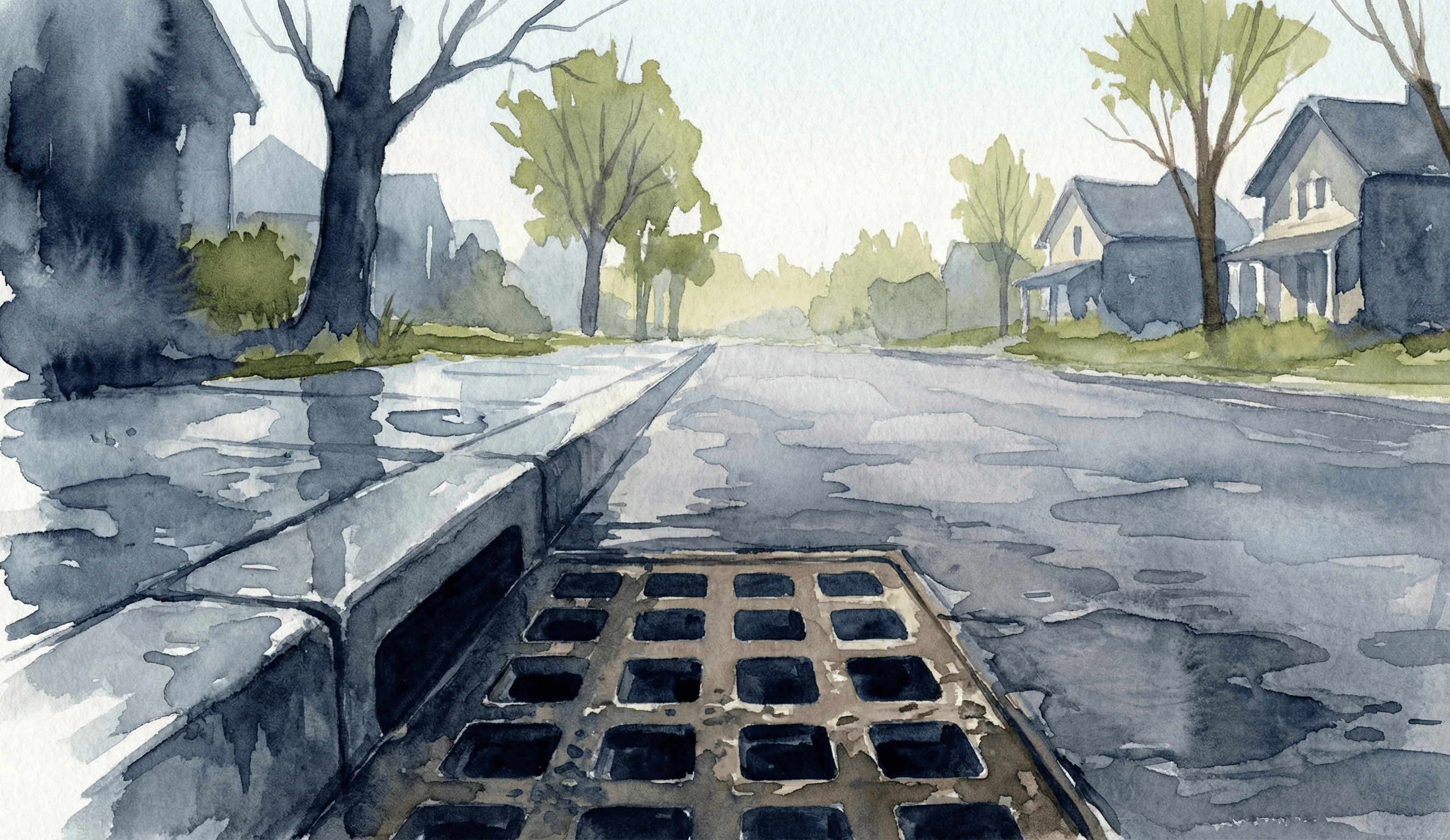
1. Windows
Claire
By the second week he had a clipboard.
Before that he was just a man across the greenbelt, standing by the storm drain like he’d wandered onto the wrong errand and didn’t want to admit it. No dog, no earbuds, no prop to explain himself. The first two mornings he kept his hands in his pockets. On the third he crouched, pulled a mat of wet leaves off the grate, and put it in a grocery bag.
I already knew that grate. Last summer I watched water disappear into it much slower than the city said it should. “Everything worked as designed,” the inspector told Hazel while she wrung out towels in her driveway. I still hear that sentence whenever someone says something is probably fine.
The first few days I wrote him off as a passerby taking a long pause. People stop to check a text or fish for a key. They don’t come back the next morning with work gloves.
But he kept returning. And he stayed long enough that I wiped an already clean counter and pretended I was the reasonable one.
He didn’t lift the grate or reach through it. He stayed at the surface. He picked out a crushed cup, brushed grit away from the curb opening with one glove, then stood and watched the thin leftover water move.
The house was quiet too. Empty-nest quiet. Not sad, exactly. I could just hear everything now: the fridge hum, the dishwasher click, the small throat sound I made swallowing coffee.
For nineteen years mornings were cereal boxes, cabinet doors, my son thumping through routines he denied having. “Do we have any more cinnamon toast?” “Where’s my form?” “Where’s my other form?” Then he left for college, my ex moved into a condo with a gym towel service, and there was nobody left to ask where the forms were.
So I kept the old ritual, standing at the kitchen window between 7:15 and 7:45, pretending it was deliberate and not just leftover muscle memory. The window faced the greenbelt and the outer curve of Brookside Drive. Oaks along the street dropped leaves into everyone’s gutters like they were running a competition.
After Hazel’s flood, I learned to track the water level without meaning to. I could hear the downspout choke on a single clump of maple seeds. I checked the gutter and the low place by Hazel before I checked the forecast.
Then I started checking for him too.
He was maybe early fifties. Or an exhausted mid-forties. Jeans, jacket, sturdy sneakers. Nothing that answered the question.
Eventually he caught himself lingering. He looked up, made a small embarrassed circle with his head, and walked back along the greenbelt. When he passed under the Hazel Court sign, I placed him: the rental three houses down from the one with mismatched porch bulbs.
The next morning he reappeared. And the next. By day five the hat changed, the posture didn’t. Feet apart. Hands in pockets. Shoulders square to the drain.
Then came the clipboard. Yellow. Full size. He wrote in short bursts, held the page at arm’s length, then wrote more. One morning he stretched a string from one crack in the curb to another and clipped a little level to it. Another day he measured the mouth of the drain with a folding rule, swept a ridge of grit out of the gutter, and measured again.
Whatever he was writing, it had columns. He kept moving between the same low spots, maybe remembering what the water had done last July.
Meanwhile, my days were too long. I learned which dog walkers dressed for the actual temperature and which porch lights had burned out. I knew the minivans by their dents. I watched because the window was there and so was I.
Once I knew roughly when he came by, I started looking up at 7:30 without deciding to.
After a week of him and his clipboard, I opened the Brookside Residents group. I usually only read it. This time I started a post.
I typed:
Anyone else noticing the guy with the clipboard at Hazel & Brookside?
Is he with the city?
He seems very committed to that storm drain.
I deleted “very committed,” looked out the window, and put it back.
Replies trickled in:
He’s city.
He’s definitely not city.
Contractor?
Concerned citizen?
At least he’s quiet.
Someone suggested “lawsuit.” One woman asked if anyone had gotten his license plate. No one had, which kept the thread from becoming worse than it already was.
“At least he’s quiet” was the closest thing to consensus. The shed-height argument had lasted four months. Trampoline placement had needed a special meeting. We knew how to keep a subject alive.
I still didn’t know his name. I knew he arrived before eight, never lifted a grate, and carried the leaves away instead of kicking them into the gutter. For the moment, that was enough.
2. The Route
Miles
You learn people by the way they take their mail.
Some pull everything out fast, like they’re trying to beat a timer. Some pinch envelopes like they’re handling evidence. Some sort on the spot: bill, junk, unknown, probably bad news. And some open the door just wide enough to snag the stack before you can say hello.
Do a job long enough and your brain starts categorizing for entertainment. I’ve been on the Brookside loop for years, and I keep a private system. Not official, not organized, just ways of noticing.
A scribble on my route sheet means “dog loose but friendly.” A star means “says thank you.” A diagonal slash means “timing me.” A circle means “heavy week, hand it over gently.” A question mark means “story forming; keep an eye.”
Management never sees these marks. They want the scanner to beep and the truck to keep moving. By noon it has usually told me I’m behind at least twice.
I’m 58. Mailman-old, not people-old. My knees complain on inclines, and porch stairs work on my back one riser at a time. My doctor says I’m in good shape “for the job.” I know what the quotation marks mean.
Brookside is a decent route. Flat enough. Trees for shade. Sidewalks mostly honest. You get used to the neighborhood’s rhythm: Halloween inflatables appearing overnight, trash cans migrating like lost livestock, the one house that switches to Christmas at exactly 12:01 a.m. on November first.
Last July the bottom of Hazel turned into a shallow canal. Water reached three garage doors. People in rubber boots kept repeating what the inspector had said: the system had “performed as expected.”
The first time I saw him, he was waiting at his mailbox.
That happens. Folks expecting packages stand around pretending to enjoy the breeze. Usually you can guess the content. Gym shorts, electronics, a suspiciously light box someone doesn’t want a spouse to open.
This guy wore jeans, a plain shirt, a jacket that once had a logo. Hands in pockets like he wasn’t sure if intercepting your own mail was good manners.
His box was third in the cluster: Hart, E. I meet people as handwriting before anything else. His “E” was small and careful, like someone who didn’t rush forms.
He watched the scanner light until it went green.
“Getting anything good today?” I said. Route-standard banter.
“It’s all data,” he said.
Not a typical answer. Not wrong. Just sideways.
Three items: hardware circular, refinancing ad, padded envelope with no logo. Could’ve held anything from a part to a personal project.
“Package for you,” I said.
He weighed it in his hand before reading the label. Not suspicious, more like calibrating.
“I appreciate you,” he said. Not “thanks.” Not “take care.” I appreciate you.
I put a small question mark next to his number.
A few days later I saw him at the corner. Standing by the storm drain like he’d been dropped there by a crane. Same posture: thinking without moving.
“Out early,” I said when I reached his box.
“I wanted to see where it all goes,” he said.
“Mail?”
“Water.”
Right. Water.
He started receiving more packages. Long ones, heavy ones. A measuring wheel showed up first, then a folding rule, a narrow curb broom, work gloves, orange marking flags, and a contractor’s line. After that, I’d see him pace the curb, write down a distance, and double back. On wet mornings he raked leaves off the grates and bagged them. Once he set a short level on the curb, turned it around, and checked the same spot again.
“New toy?” I asked once.
“Trying to understand the street,” he said. “Before it surprises me again.”
He said it as if the street had already done this once and might try again.
That night I underlined the question mark.
I keep a small notebook at home, nothing official. Just lines I want for later. The dog that leaves tennis balls in exchange for gloves. The kid who wore a cape for two years and then went silent until high school softened him again. The woman who left iced tea in July “for whoever,” which always means “you.”
Eldon Hart went in with a single line:
Man with wheel working the drains. Consistent.
3. Assignment
Cass
My desk at the Herald sat between a copier that jammed twice a day and a window facing the HVAC units of the building next door. The window didn’t open. I could tell which tray had jammed by the sound.
I was halfway through my second cup of newsroom coffee. Burnt, metallic, comfortingly predictable. I scrolled the police blotter for anything with shape. Most of it was the usual: loud music resolved before arrival, possible trespasser identified as UPS, a cow on County Road 8 reunited with its owner.
At nine-thirty, an email popped up. Subject line:
Drains guy
At our paper, anything labeled “___ guy” could go either way. “Train Guy” was a retiree with a model railroad. “Mall Guy” lived in a defunct department store for two weeks.
The email, from Denise:
A few calls about a resident poking around storm drains on Brookside Court.
Non-emergency line checked. No crime.
Could be local color. 600 words max.
“Local color” is code for: don’t come back empty, don’t come back ambitious.
I pulled up the dispatch notes.
Caller reports male subject examining storm drains.
Fifties, jeans, clipboard.
Measuring equipment.
Officers made contact; subject states he is “mapping runoff.”
No further action.
Mapping runoff was specific enough to get me out of the office.
I opened a map of Brookside: curves, cul-de-sacs, and retention ponds named like real lakes. The subdivision looked orderly from above.
Last July’s floods hit a few neighborhoods hard, Brookside included. The city blamed “unprecedented rainfall” and assured everyone the system had responded “as expected.” Residents described water climbing garages and said it was probably fine until it very much wasn’t.
A man mapping runoff didn’t sound so strange.
I wrote one question on a sticky note:
Why drains?
The dispatch notes didn’t say why he had started or what he did besides measure. Those were the parts I needed.
I grabbed my recorder, notebook, keys. The copier jammed as I passed, halfway through someone’s spreadsheet.
I headed to the parking lot. Denise had said 600 words. I took two notebooks anyway.