Probably Fine

III. The Big Rain
8. Interview
Cass
When I finally interviewed him, he looked more nervous than I felt, which took effort on his part.
He was posting a new laminated sheet inside the trailhead box on the greenbelt path. The old one had curled at the edges. He peeled it up carefully, smoothed the new one against the plexiglass, and pressed out each air bubble with his thumbnail.
Up close, the map was even denser: more arrows, more tiny notes in the margins, little circles marking dips in the path, numbered driveways, a star beside the date of the old flood.
“Hi,” I said, raising my notebook like a hall pass.
“Hi,” he said. His eyes dropped to my press badge. A blink, then: “You’re from the paper.”
“Thanks for emailing back.”
He nodded once and checked the corner of the map he had just taped down.
“Mind if I ask a few questions?” I said.
“Sure,” he said. “Answers might be boring. That’s ideal for drains.”
We stepped aside for a jogger and an ecstatic off-leash dog. Neither of us sat on the bench.
“Just to get it right,” I said. “Eldon…?”
“Hart,” he said. “Eldon with one L. Not that anyone spells it with two. My mom just… pointed it out a lot.”
I wrote it.
“So what started all this?”
He took a long breath and glanced down Hazel toward the lowest point of the street.
“There was a storm,” he said. “Last summer. Forecast said ‘light showers.’ We got four inches.”
He gestured with his palm, raising it slowly from his shin.
“Street filled up to here. Then it came around the curb and up the driveway. It followed the grade.”
He sounded as if he had checked the number more than once.
“The garage door held for maybe a minute,” he said. “Weatherstripping bowed in and out like it was breathing. Then the water pushed under and came in.”
“And after?” I asked.
“After,” he said, “the city called it ‘historically unprecedented.’ Insurance called it ‘an act of God.’ The adjuster called it ‘one of those things.’”
He shrugged.
“I kept looking at the curb,” he said. “The water had come from uphill. I wanted to know exactly which way.”
“You started with your driveway.”
“Then the gutter. Then the corner. Then the eight curb cuts and side drains uphill that feed into the corner.”
He tapped the plexiglass of the map lightly.
“How long have you been doing this?” I asked.
“Since January,” he said. “On and off. More on lately. I work internal support. I’m used to finding out where something failed after everyone says nothing changed.”
“You work in tech,” I said.
“Internal support,” he said. “Servers. Systems. At least out here I can see the slope.”
“Do you have an engineering background?”
“No,” he said. “I read a few city planning blogs. I like diagrams. That’s the résumé.”
“How much of this is measuring?”
“Most of it. I photograph the low spots after rain, time how long puddles take to clear, measure the curb openings. If leaves are sitting on a grate, I rake them off. I clear the little channels along the curb.”
“And the repairs?”
“Only on private property, and only small things. I re-bedded two pavers at my driveway and fixed a downspout extension. Helped a couple neighbors do the same. I don’t lift grates or climb into anything. I’m nosy, not stupid.”
“Why the flags and chalk?”
“Because otherwise every puddle turns into ‘the bad one by the tree,’” he said. “I needed dates and measurements.”
“And the laminated map?”
He winced.
“I thought if I put one out here, people might understand what I was doing. Or at least stop assuming it was some kind of… ritual.”
“Has it helped?”
“A couple people clear the grate before storms now,” he said. “One family moved its yard bags uphill. That helps.”
A runner passed, oblivious to the map under her elbow.
“What’s the best outcome?” I asked.
“That nothing happens,” he said. “Rain comes, the inlets stay clear, nobody gets water under a door.”
“And the worst?”
“That it happens again and we lose an hour figuring out what I could have written down now. Or that I’m wrong and I’ve planted forty little flags for nothing.”
“I’m not saving anyone,” he said quickly. “I just don’t like being blindsided by preventable things.”
“What should I call it in the story?” I asked.
He looked back at the map.
“A drainage map,” he said. “Please don’t call it a mission.”
9. Margins
Miles
The letter from the city changed the way he stood.
I saw it arrive. Thin envelope, city crest, his name visible through the window.
I slid it into his stack. By the end of the block I was still wondering about it.
When I looped back on the other side of Brookside, he was already on the porch, envelope torn open. His other mail—circulars, offers, a gutter-cleaning flyer—sat untouched beside him. His shoulders had dropped.
“They noticed my map,” he said.
“Good notice or bureaucratic notice?” I asked.
“The polite kind,” he said. “Commendable initiative.”
He read from the letter:
“‘We appreciate engaged residents taking an interest in stormwater infrastructure… however, for reasons of safety and liability, please refrain from placing markers or materials on city-owned structures or rights-of-way. Do not interact with city-owned infrastructure without prior authorization.’”
He lowered the page.
“They like the word ‘interact,’” he said. “Used it three times. Interact with grates. Interact with culverts. Interact with retention basins.”
He folded the letter once, then again.
“What did you actually do?” I asked.
“Chalk lines. Some flags. I swept grit out of two curb openings and moved a yard-waste bag away from one. According to this, I’ve compromised the integrity of the municipal drainage system.”
“Are they threatening you?”
“No. ‘We kindly request.’ ‘We remind you that.’ There’s a number I can call for ‘approved channels for citizen feedback.’”
“Going to call?”
He ran a thumb over the phone number.
“I’ve worked the other side of those lines,” he said. “You read the script, feel vaguely guilty, then fix what you were going to fix anyway. Or don’t.”
Hazel and Brookside were dry. A line of maple seeds had already started collecting along the gutter.
“Are you going to stop?” I asked.
“I’ll stop drawing on curbs,” he said. “Apparently chalk is a gateway offense.”
“And the rest?”
He gave a little helpless shrug.
“I know the low spots now,” he said. “I know what the drains sound like when they’re already full. I don’t need chalk for that.”
He tucked the letter back into the envelope.
“I don’t want to be responsible for anything,” he said. “I just hate being surprised in ways you didn’t need to be.”
I understood him. I also understood why the city had sent the letter, which was inconvenient.
Down the block a kid kicked a soccer ball into his garage door over and over. Sprinklers came on across the street while puddles were still drying.
That night I opened my notebook. The route sheet sat underneath, covered in my private notations. Stars. Slashes. Circles. Nothing official. Just my own way of understanding who lived along this loop.
Under “Local Expertise,” I had already written:
E. Hart --> knows the low spots.
I added:
City told him not to touch the drains.
Still making rounds anyway.
I had a bid form on the table, an easier route closer to the depot. Fewer hills. Less bending. Cleaner sidewalks. My joints were lobbying hard.
But I knew Brookside. I knew the kids, the loose dogs, which steps tilted, and who would be waiting by a mailbox after a storm.
The kettle whistled. I left the form beside it.
10. Overflows
Claire
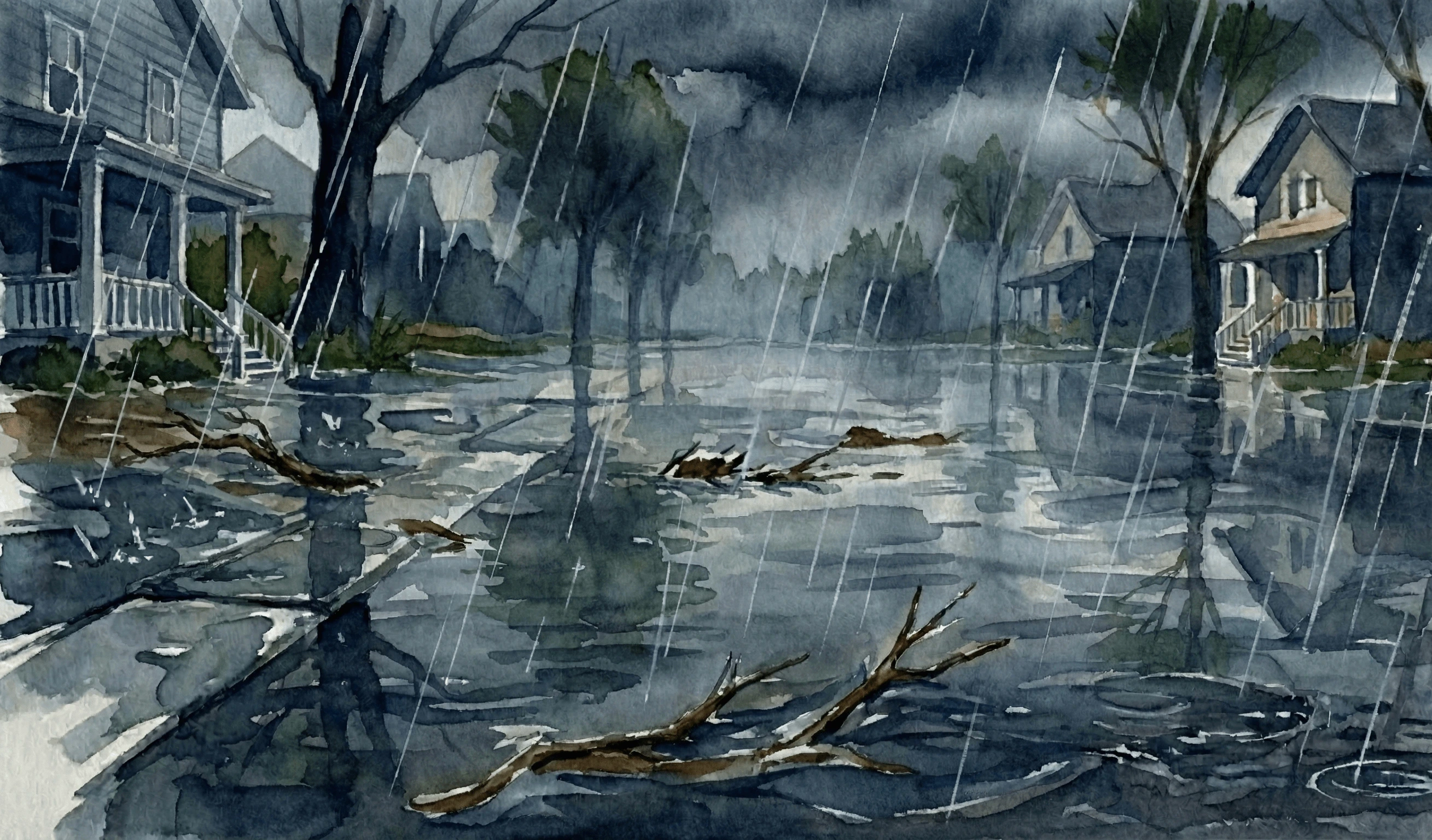
The forecast said “showers,” which around here covers almost anything.
By afternoon, the cloud icon on my phone had added three lines. By evening, the forecast said “periods of heavy rain.” I moved the doormat inside.
I’d noticed he’d been out less since the city letter. No chalk. Fewer flags. Some mornings just a walk, hands tucked in pockets, eyes not searching so much as scanning.
Then, sometime between chopping garlic and burning the first handful, the rain smacked the kitchen window hard enough to startle me. By the time I walked to the front room, water was running curb to curb.
Streetlights came on early. Through the front window I could barely make out the far curb.
My phone started buzzing with the neighborhood text thread.
anyone else getting water near back door
our power flickered
trampoline is NOT floating josh
brookside looks bad
is this another july thing??
Then, through the moving blur outside, I saw him.
Ankle deep at the corner. Hood half-on, jacket zipped to the chin. He dragged his narrow rake along the curb and pulled a branch, leaves, and a flattened takeout container away from the grate. Water still backed up around his boots.
A car rolled through the water, waves slapping against his shins. He stepped back, let it pass, then moved right back into place.
More texts:
water coming up fast
anyone know which drains connect????
He looked uphill, dropped the rake on the grass, and jogged up Hazel Court. He cut between two yards, vanished behind the Delgados’ hydrangeas, then reappeared beside the small drain box near their back fence, a feature I’d never noticed in twenty years of living here.
Lily Delgado followed him out, barefoot, sweatshirt plastered to her arms. They dropped into a crouch at the drain, hands scooping clumped leaves and soaked grass away from the metal grate. He worked like someone who’d already rehearsed it.
On the thread:
water coming in under my parents’ back door at hazel help
I stood there with my phone in my hand.
The waterline at the Delgados’ sliding door stopped advancing. The patio reflections thinned. A small whirlpool formed above the drain as the blockage loosened.
Another text:
whoever helped my parents THANK YOU
was that the wheel guy??
sorry for calling you weird earlier
He stayed until water stopped backing up around the drain. Lily said something to him, drowned out by the rain, and ran inside, leaving a trail of wet footprints behind her.
By midnight the storm moved on. Twigs and one recycling bin lay in the road. The low point near the corner held a shallow puddle and nothing worse.
Most people called it “crazy weather.” From my window I had watched him clear the first grate, read the way the water was still rising, and run uphill to the blockage that mattered.